
How to Read Palm Lines and the Whole Hand
To read palm lines, start with the whole hand rather than a single crease: choose which palm to read, look at its shape and texture, then follow the main lines and see how they relate to the mounts around them. Palmistry is an interpretive tradition, so each feature is read as a description of tendencies and temperament, not as a forecast. The steps below go in the order most palm readers use.
Heart Line
how you love, express feelings, and relate to others
Head Line
how you think, learn, and make decisions
Life Line
your vitality, energy, and major life changes
Fate Line
your career path and sense of life purpose
Try Palm Reading
Upload a photo of your palm and receive an instant reading of your lines, mounts, and hand shape.
What would you most like your palm to reveal?
The next step connects your palm lines to a personal reading.
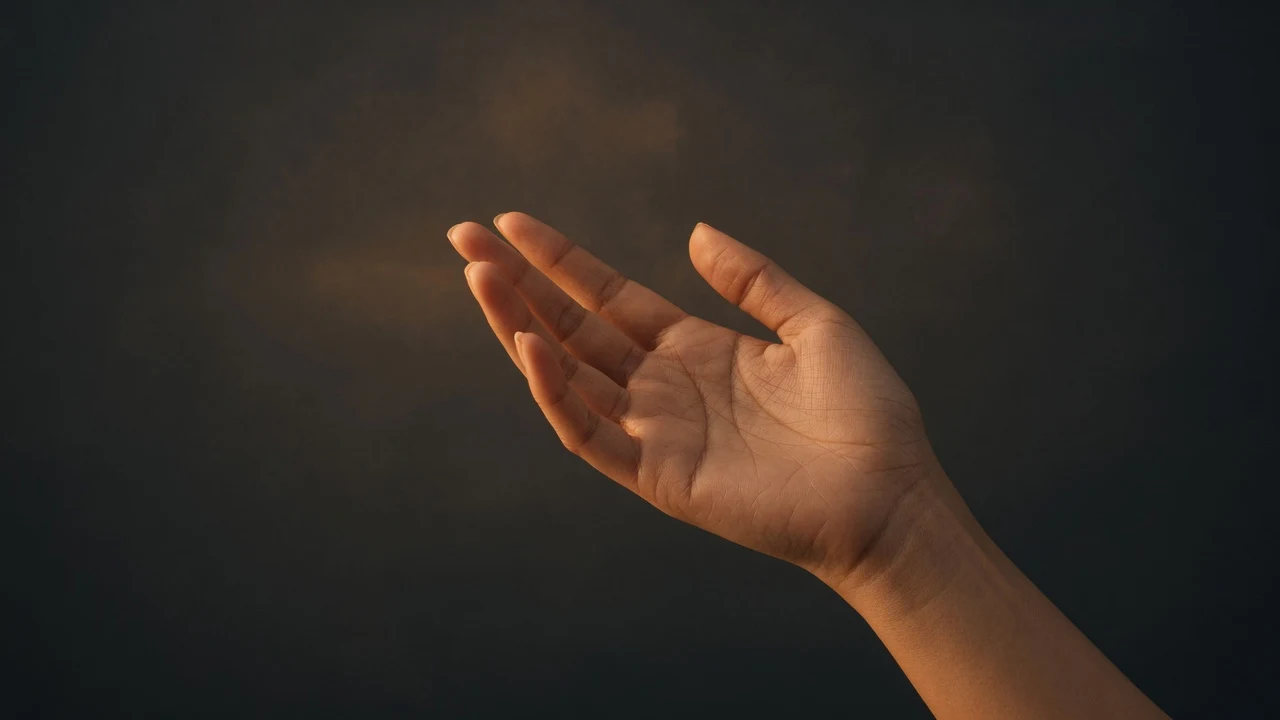
Which palm do you read, and where do you start?
Most palm readers start with the dominant hand, the one you write with, and treat it as the hand of your present life and the choices you have made. The other hand is often read as your starting point or natural leanings. Comparing the two is a common part of a reading: where they differ, readers talk about change; where they match, about steadiness.
Before looking at any line, look at the hand as a whole. Notice its shape, the length of the fingers compared with the palm, whether the skin feels firm or soft, and how the hand rests when it is relaxed. Good light helps, and so does gently cupping the hand so the creases deepen. That first overview frames everything you read afterward.
How to read the lines on your palm
Once you have the overview, follow the main lines one at a time. For each, note where it starts and ends, how deep and clear it is, whether it curves or runs straight, and whether it forks, breaks or has small branches. Depth and clarity are usually read as strength of focus, while forks and branches are read as variety or a shift in direction.
Manuals have never fully agreed on how many lines count as main lines. Cheiro listed seven important lines and seven lesser ones, while William G. Benham counted six main lines. In practice, most readers begin with the heart, head and life lines, then look for the fate line, which not every hand shows clearly.
One point needs saying plainly: a short, faint or broken life line does not mean a short life. Palm readers who use it at all read it for energy and the way you meet change, never for lifespan.
Palm reading lines together with hand shape and mounts
A palm reading becomes useful when lines are read in context rather than one by one. A strong head line on a square, practical hand is often described differently from the same line on a long, slender hand with tapered fingers. The mounts, the fleshy pads at the base of the fingers and thumb, add another layer: a line that runs toward a full mount is read as drawing on the qualities palmists link with that area.
Look for patterns rather than single signs. Several lines pointing the same way, or a mount that stands out on an otherwise flat palm, carry more weight in a reading than one isolated mark. When features seem to contradict each other, readers usually describe a tension between two tendencies rather than declaring one of them wrong.
Lines also shift over the years, which is one reason readers like to compare both hands and to look again after some time.
Traditions and folk meanings
What palm lines are, physically
Anatomically, palm lines are flexion creases. They are folds where the thick skin of the palm is anchored to the tissue underneath, so the hand can bend while gripping. An anatomist wrote the palmistry entry for the 1911 Encyclopaedia Britannica and described the lines in just these terms.
That explanation sits comfortably next to palmistry as a reflective practice: the creases are real, and the meanings are a tradition of reading them, not a medical or scientific finding.
Look at both of your palms side by side for a minute. Where they differ, ask yourself what has changed in the way you live compared with where you started.
Palm Lines
Heart Line
The heart line runs horizontally across the upper palm, starting from beneath the little finger and extending toward the index or middle finger. It is the topmost of the three major lines.
The heart line reveals your emotional nature — how you love, how you express feelings, and how you relate to others in intimate relationships. A long, curved heart line suggests warmth and emotional openness, while a straight heart line may indicate a more rational approach to love.
Read the full heart line guideHead Line
The head line begins at the edge of the palm between the thumb and index finger and stretches horizontally across the middle of the palm. It sits between the heart line above and the life line below.
The head line reflects your intellectual style — how you think, learn, and communicate. A long, straight head line suggests analytical thinking and focus, while a curved head line points to creativity and imagination. The depth of the line indicates mental intensity.
Read the full head line guideLife Line
The life line arcs from the edge of the palm between the thumb and index finger, curving downward around the base of the thumb toward the wrist. It is often the most prominent line on the hand.
Contrary to popular myth, the life line does not predict how long you will live. Instead, it reflects your vitality, physical energy, and major life changes. A deep, well-defined life line suggests robust energy, while a faint line may indicate a more contemplative or low-energy temperament.
Read the full life line guideFate Line
The fate line (also called the destiny line) runs vertically from the base of the palm upward toward the middle finger. Not everyone has a visible fate line, and its absence is perfectly normal.
The fate line reflects how strongly external circumstances — career, duty, and life events — shape your path. A strong fate line suggests a life guided by a clear sense of purpose or external responsibilities, while its absence may indicate a self-directed person who forges their own path independently.
Read the full fate line guideHand Shapes
In palmistry, the overall shape of the hand is classified into four elemental types. Your hand shape reveals your core temperament and how you engage with the world.
Earth Hand(Earth)
Square palm with short fingers. The palm width and finger length are roughly equal.
- Practical and grounded
- Values routine and stability
- Reliable and hardworking
- Prefers tangible results over abstract ideas
Air Hand(Air)
Square or rectangular palm with long fingers. The fingers are noticeably longer than the palm width.
- Intellectually driven
- Excellent communicator
- Curious and restless
- Thrives on variety and mental stimulation
Water Hand(Water)
Long, oval palm with long, slender fingers. The hand has an elegant, narrow appearance.
- Highly intuitive and sensitive
- Creative and imaginative
- Emotionally perceptive
- Drawn to art, music, and the spiritual
Fire Hand(Fire)
Long or rectangular palm with short fingers. The palm is noticeably longer than the fingers.
- Energetic and bold
- Natural risk-taker
- Charismatic and inspiring
- Action-oriented and impatient with details
Major Mounts of the Palm
The mounts are the fleshy pads on the palm, each named after a celestial body. A well-developed mount indicates strength in that area; a flat mount suggests that quality is less dominant.
Mount of Jupiter
Below the index finger
Ambition, leadership, confidence, and spiritual aspiration.
Mount of Saturn
Below the middle finger
Responsibility, discipline, wisdom, and introspection.
Mount of Apollo (Sun)
Below the ring finger
Creativity, vitality, success, and artistic talent.
Mount of Mercury
Below the little finger
Communication, intelligence, commerce, and wit.
Mount of Venus
Base of the thumb
Love, sensuality, passion, and vitality.
Mount of Luna (Moon)
Opposite side of the palm from the thumb, lower area
Imagination, intuition, creativity, and the subconscious.
Frequently Asked Questions
When palm reading, which palm do I read?
Start with your dominant hand, which most readers link with your present life and choices. The other hand is often read as your natural starting point. Comparing both is a normal part of a full reading.
Is there a chiromancy guide to how many main lines there are?
Chiromancy is another name for palmistry, and its classic manuals did not agree on the count. Cheiro listed seven important lines and seven lesser ones, while William G. Benham counted six main lines. Most modern readings begin with the heart, head and life lines.
Does a short life line mean a short life?
No. A short, faint or broken life line does not predict how long you will live. Palm readers who use it read it for vitality and how you handle change, and the line itself is simply a skin crease.
Can palm lines change over time?
Lines can deepen, fade or gain small branches over the years, which is why palm readers often compare both hands and revisit a reading later. They read such changes as shifts in focus, not as events on a timeline.
Researched and written with AI assistance, following the Lucid Oracle editorial guidelines. How our interpretations are written
For entertainment and personal reflection — not a substitute for professional advice.
Personal insights powered by AI
Try Palm Reading
Upload a photo of your palm and receive an instant reading of your lines, mounts, and hand shape.